The question before which gooseneck
Most pages about gooseneck kettles start by assuming you need one and go straight to which. This page starts one step earlier. The kettle already in the kitchen boils water; a gooseneck kettle also boils water. What the thin curved spout adds is control over two things, how fast the water leaves and where it lands, and whether that control is worth paying for depends entirely on what the water is being poured onto.
What the spout changes
A wide kitchen spout pours in a broad, fast stream that is hard to slow down and harder to aim. A gooseneck narrows the stream and puts the opening far out on a curve, so a small tilt gives a thin, steady pour that can be placed on one part of a coffee bed and moved across it. Pour rate and placement are the whole of it. Nothing about the spout changes the water's temperature, and nothing about it changes the coffee.
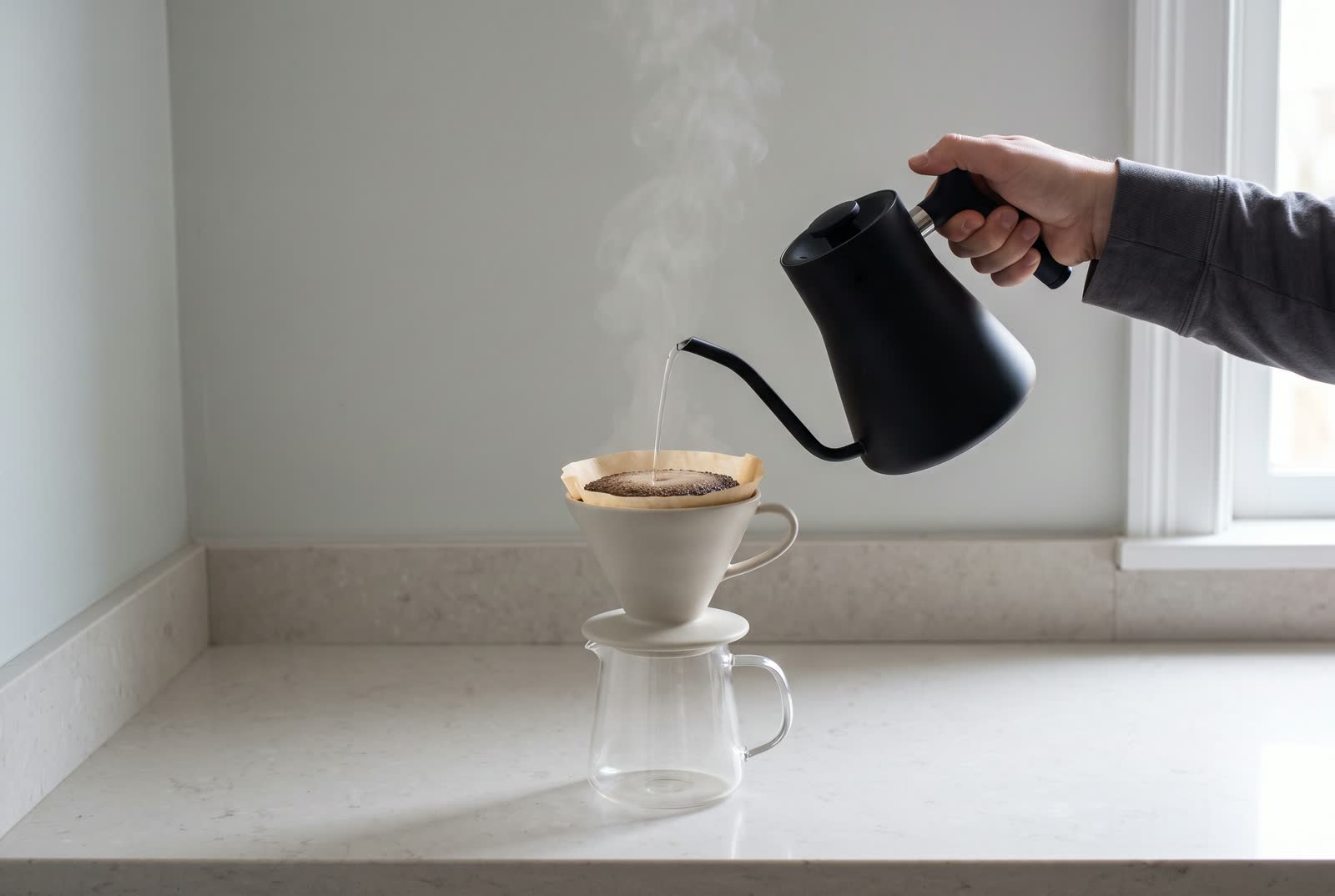
That control matters for exactly one family of brewer: the ones where the water is poured by hand over the coffee and passes through it once. A pour-over cone is the plain case. Its maker states a porcelain dripper, a glass server and a hundred paper filters, and the pour is the only variable the brewer leaves to the person holding the kettle. Pour too fast and the water runs through the bed before it has extracted; pour unevenly and one side of the bed is over-extracted while the other is dry. The gooseneck is the tool that makes those two mistakes avoidable.
Which brewers the kitchen kettle already suits
A French press is filled in one go and stirred, and a wide spout does that as well as a thin one. A moka pot's water goes into a chamber, not onto coffee. An espresso machine takes its water from its own tank and never meets a kettle at all. A drip machine has its own shower head. For every one of those, the kettle in the kitchen is the right kettle, and a gooseneck is money spent on a control the brewer never uses.
So the question is answered by the brewer, not by the kettle: a cone, a flat-bottom dripper or any brewer poured by hand rewards a gooseneck, and everything else does not.
What the one gooseneck on this record states
The Stagg EKG Pro is the gooseneck kettle we have figures for, and its maker page states variable temperature control with presets, a one-hour keep-warm, auto shutoff and a gooseneck spout for pour control. Its page, read on 6 September 2026, prints 11.10 by 6.77 by 7.7 inches, 1,400 g with its base, and 110 to 120 volts at 1000 to 1200 watts; an earlier read of the same page states a 1200 W heating element on a US plug. On Fellow's page, read the same day, it states a 30 oz capacity, which is 0.9 litres, and a two-year limited warranty.
Two of those figures are what separate it from the kitchen kettle beyond the spout, and both are worth naming honestly. The temperature control is a feature the cone can use, because water off the boil and water at a set temperature extract differently, and a kettle that holds a temperature removes one variable from a hand pour. The keep-warm is convenience. Neither is the spout, and a reader who wants only the spout is paying for the other two as well.
One thing about the name: this listing was renamed to the Pro by an owner ruling on 4 September 2026, because every variant sold at the maker's page is a Pro or a Pro Studio Edition and the plain EKG is not on offer there. The figures read on 6 September are the Pro's. The earlier reading, the 1200 W element among it, is another matter: the source check found that the page's specification block does not say whether it describes the EKG or the Pro, so those figures stay unattributed and unknown for this listing, and we have marked them that way.
The kettle in the kitchen
No ordinary kettle is on this site's record, so no figure is stated for one: not a capacity, not a wattage, not a pour rate. What can be said without a figure is what it is: a kettle that boils to one temperature and pours from a wide spout. For a press, a pot or a machine that is everything a kettle needs to do.
The decision
A reader with a cone, or planning one, is buying pour control, and a gooseneck is the tool for it; whether it also needs a temperature dial is a second question, and the page on kettles and temperature answers which brewer wants which. A reader with a press, a pot or a machine already owns the right kettle.
No price on this page is checked at a seller. The kettle and the cone above sit in the bands this site draws, which are ranges of its own framing and not a figure read at a shop.



