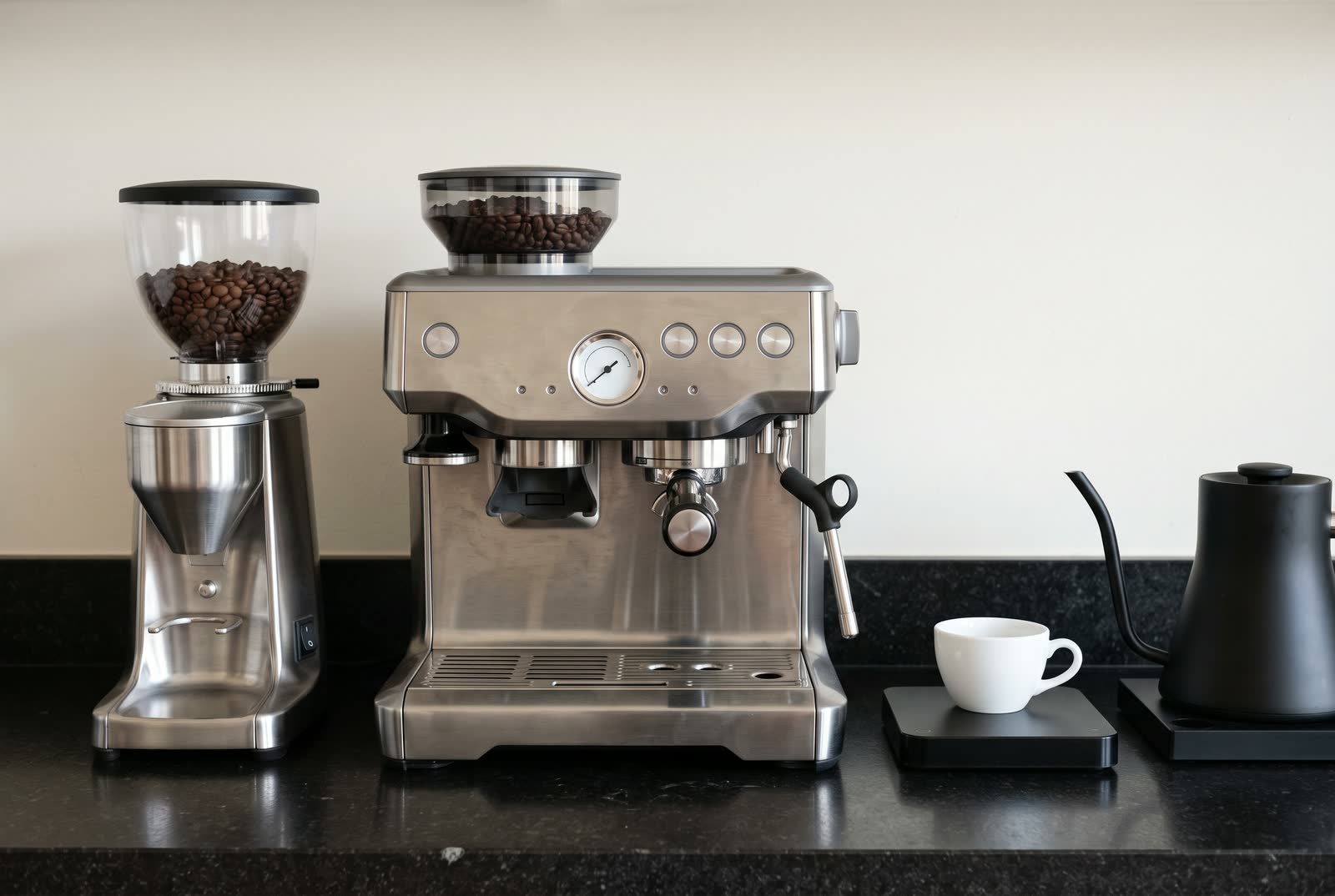
What the top of a category is here, and what it is not
This is the most expensive corner of a home setup, and the first honest sentence about it is that the text below quotes no price: a price shows only on a product's own card, where it was checked at a seller and carries the day it was read. What the text can do instead is read what the maker at the top of each part of a setup publishes, against what the cheaper thing in the same part publishes, and say which figure actually changes. Four products stand at the top of four categories on this record: a machine, a second machine of a different kind, a grinder and a scale. Every figure below is a maker's own, with the page and the date it was read from, and not one of them is a price. Two of the four, the Oracle Touch and the Forte AP, are linked to their product pages. The Dream PID and the Lunar are named and not linked, and so is the Basic 3 further down, because none of the three yet has both a picture and a checked price on record, which is what a product page here needs.
The machine: what a second boiler adds
The Oracle Touch's maker page, read on 5 September 2026, states a dual boiler, a commercial-grade 58 mm portafilter, 45 grind settings, an 84 oz water tank, 1800 watts and a two-year warranty, in a body of 16.2 by 15.2 by 14.4 inches weighing 35.54 lb. Its own manual, read on 6 September 2026, prints the tank as top-fill, 84 fl oz or 2.5 L, with an integrated water filter and a backlit level indicator. Two boilers is the figure that separates it from everything else on this record: it is the only machine here whose maker states a dedicated espresso boiler and a dedicated steam boiler, and at 16.12 kg it is also the heaviest machine on it. One more thing belongs in this section and it is the thing to read before anything else in it: the maker's own page, read on 10 September 2026, carries the sentence that the model has been discontinued, with every offer on that page reading sold out and no price rendering at all. That is a statement about the model made by the maker on a day, not a shop's stock flag, and the figures above stand unchanged beside it.
The other machine: what a number on the control adds
The Dream PID's page, read on 5 September 2026, states 245 by 345 by 280 mm, 10 kg, 1100 watts, a 1.3 litre tank, a 58 mm stainless portafilter and an externally adjustable over-pressure valve. Its temperature line, read on 13 September 2026, is the one figure on this page that no competitor matches: a PID control set from the display, over 80 to 110 degrees Celsius in one-degree steps, which is the only published temperature range on this whole record. So what the money buys in this row is a number you can set and read back, rather than a badge on a spec sheet. Its manual, read on 6 September 2026, also carries the plainest placement instruction of any machine here, which is that the appliance is not to be placed in a cabinet or similar when in use, and that is a sentence to read before a cabinet gets measured.
The grinder: flat burrs, and a scale inside the machine
The Forte AP's maker page, read on 5 September 2026, states 54 mm flat ceramic burrs, a burr speed of 1950 rpm, a built-in 0.1 g scale and a 0.1 second timer, a 300 g hopper, a body of 13 by 18 by 37 cm, 130 watts and a one-year warranty. The Encore, the entry grinder from the same maker, states 40 mm conical steel burrs and forty grind settings over a range of roughly 250 to 1200 microns. Of every grinder on this record, the Forte AP is the only one whose maker states a scale inside the machine, and that is the figure the money buys here: it is about dosing rather than about grinding. Worth holding the warranties side by side while deciding, because the top machine above carries two years and the top grinder carries one.
The scale: a readability nobody else publishes
The Lunar's maker page, read on 3 September 2026, states 105 by 105 by 15 mm, 265 g plus or minus 5 g, a maximum capacity of 2000 g, a 5 V supply and a two-year limited warranty that covers water damage. The same page re-read on 11 September 2026 prints the figure that actually separates it: a readability of 0.1 g with 0.01 g selectable, beside a repeatability of 0.1 g. The Basic 3 states 140 by 120 by 20 mm, a load range of 0.2 to 2000 g and a headline accuracy of 0.1 g, given more precisely as 0.1 g from 0.2 to 500 g, 1 g from 500 to 1000 g and 3 g from 1000 to 2000 g, with an IPX3 water-resistance rating and three timer modes. The top of this category adds two published things and they are both unusual: a selectable 0.01 g, which no other scale here states, and a warranty that names water damage on a device that lives on a drip tray.
What a band is here, and why none of these four carries one
A band on this site is a range we drew for where a thing tends to sit, never a price read at a shop, and never a bound on what anything costs. Three of the four brackets have a top and the fourth, $250+, states a floor and carries no top at all, so it can never be read as an upper limit on anything standing inside it. Not one of these four products carries a bracket of any kind: for three of them no price was collected on the day their figures were read, and for the fourth the single figure that was read sat exactly on the line between two brackets with no ruling to place it. The two cheaper products named above do carry one each, the Encore in $100-250 and the Basic 3 in $50-100, and even those are our framing rather than a quotation. Neither bracket prints anywhere else on this page. The cards at the head of it carry a price only where one was checked at a seller, with the day it was read, and the Encore's card sits there as the thing the top of the grinder category is measured against, not as part of the setup this page is named for.
What the money does not touch
Three things do not improve anywhere on this page. Counter is the first: the machine at the top is the heaviest machine on this record and among the widest, and the room it takes is the same problem it would be at any price. Certainty about the shot is the second: one of these four publishes a temperature range and the rest publish a name for the control, so spending more here does not buy you a figure you can check in the cup. And a settled price is the third, and that one is ours rather than theirs, because the figures above were collected on days when no price was read at all.
How to spend here, in one paragraph
Buy the top of a category only where its published figure is one you will use. The scale's selectable 0.01 g and the grinder's built-in 0.1 g scale are both about dosing, so buying both is buying the same idea twice. The Ascaso's settable range is the only figure on this page that changes what the water does, which makes it the one worth paying for if the shot rather than the workflow is the problem. And the discontinued machine at the top is a decision about support and parts before it is a decision about boilers, which is a different question from any figure on this page and is not one this record answers.



