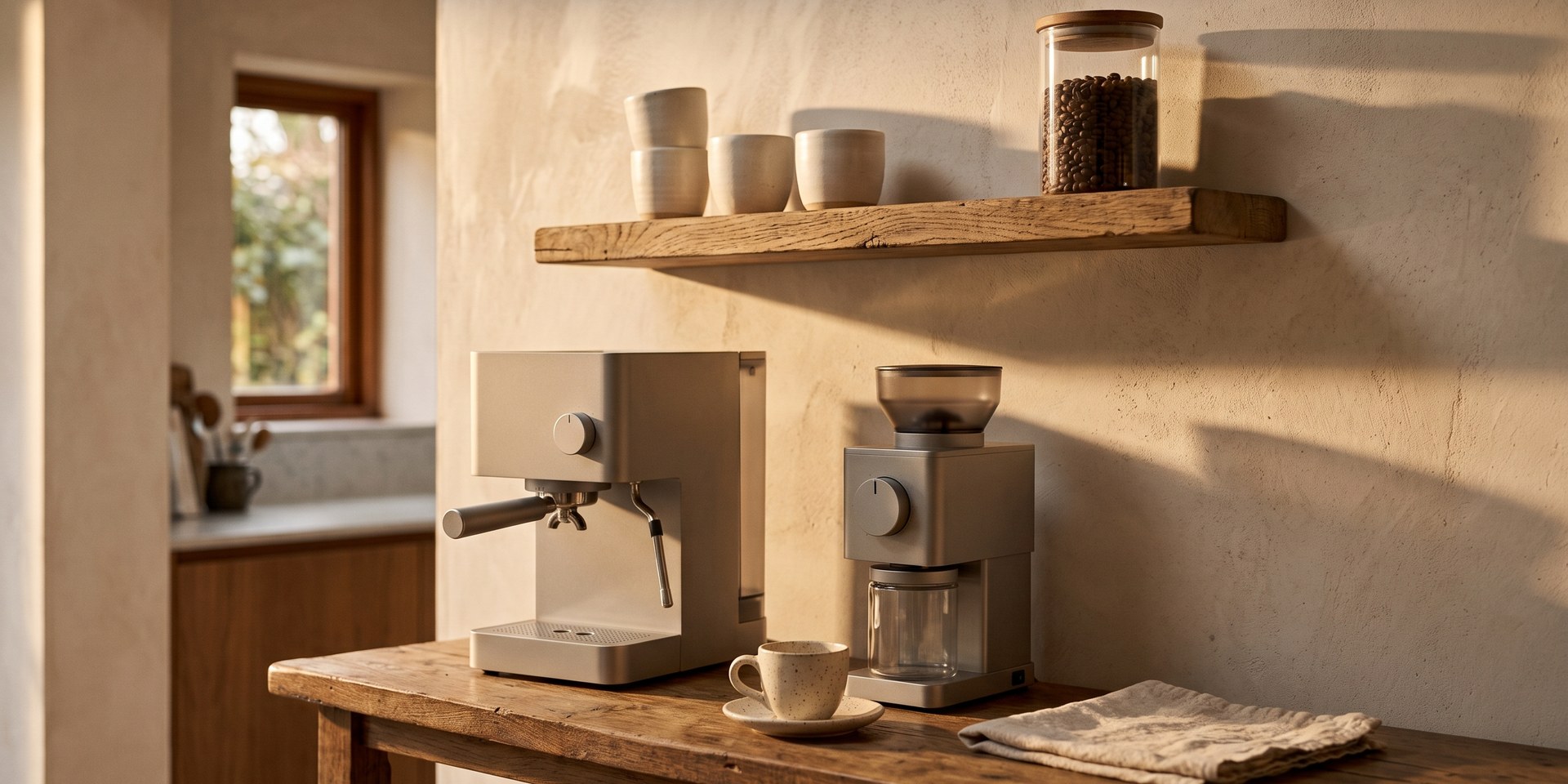
The corner you already have is most of the work
A holiday coffee station is rarely a new station. It is the everyday counter with three seasonal layers added on top: mugs that read as Christmas instead of a plain rotation of grey and white, somewhere dedicated to hold cocoa mix and cookies instead of a cabinet shelf, and a sign that tells a guest what they are looking at before they have to ask. The machine, the grinder, the tray, the spoons: none of that needs replacing for December. The three pieces below are the ones that actually change how the corner reads to a guest for the 2026 holiday season, and each is worth thinking about as a sourcing category rather than a single product to click on.
Mugs: the piece every guest actually touches
Of the three layers, mugs are where we would spend first: they are the piece a guest actually picks up. The style worth browsing is sculpted, figural holiday mug sets: four-piece sets built around 3D character designs rather than a flat printed pattern, often built around characters like a nutcracker or a gingerbread figure, with listings in this style including sets of four 18-ounce mugs. This kind of set is marketed for cocoa bars and holiday dessert pairings, and dishwasher-safe construction is worth checking for if the set is going through a lot of rounds over the holidays.
This guidance is based on sourced category listings, not hands-on testing, so treat it as a sourcing direction rather than a verdict on any single set. Keep the budget under $50 here; the character design is what carries the seasonal signal, so there is little reason to pay more for it.
Storage: the half nobody photographs but everybody needs
Mugs get the attention, but a station without a place to store the cocoa mix, marshmallows, and cookies just moves the mess to the counter next to it. Two canister styles are what sourcing turned up here: a hand-painted ceramic cookie jar with sculpted holiday characters and glossy glazes, which sits closer to a display piece than plain storage, and an iron canister with pinecone and "Merry Christmas" motifs paired with natural wood lids, which leans more farmhouse than character-driven. As with the mug sets, this is based on sourced category listings rather than hands-on testing.
The decision here is really about which look matches the mug set. A character-glaze cookie jar next to figural mugs doubles down on the same visual language; a plain iron pinecone canister acts as a neutral base if the mugs are already doing the character work. Budget a notch above the mugs for this piece, in the $50-100 range.
Signage: the layer that finishes the read
A sign is what turns "mugs and a canister on the counter" into an obvious, labeled station a guest walks up to without being told. A sign for a cocoa bar sits in a different kind of market than the mugs or the canisters: it runs on independent, mostly handmade or print-on-demand sellers rather than one repeatable stocked line, which is why our sourcing did not turn up a big-box listing to point to here; shopping for one here means browsing a marketplace category, not picking a single listing.
Within that category, hand-painted wood signs are one of the formats on offer, with sizes cited across listings running from roughly 8 inches to 40 inches wide, so the range spans shelf-scale up to wall-scale pieces; check depth and mounting on the individual listing. The same category also carries printable and digital sign files alongside personalized farmhouse-rustic canvas prints, both worth considering if a counter is tight on space or if a printed version fits the room better than a physical sign. Keep this under $50; in a marketplace category like this, size and material tend to move the price more than any seller name.
How to split the budget across three pieces
If a small seasonal refresh has one real constraint, it is not spending too much, it is spending on something the cabinet already covers. Before buying anything, run a five-minute check: count the plain mugs, spare jars, and trays already in the kitchen that could pass as neutral once the new pieces are in front of them. The waste in a project like this shows up as duplication, a second four-piece mug set bought when eight plain mugs already sit behind the new ones all December, or a second canister bought when a pantry jar would store the same cocoa mix without the character glaze. Skip the duplicate and put that money toward the one piece that is genuinely missing.
Once that audit is done, the canister set is the one piece worth spending a full tier higher than the other two. It does double duty as storage and as a display piece, and it comes back out each December rather than being consumed in one season.
The tradeoff worth naming honestly: none of these three pieces changes what the coffee itself tastes like. They change how the station looks and how clearly a guest understands what to do at it. That is the whole point of a seasonal layer, and it is also the reason to resist upgrading the machine or the grinder for this project. Those upgrades belong to a different decision, made on a different timeline, not squeezed into a holiday refresh; if the everyday station underneath needs rethinking, start with setting up a small coffee station.
Timing
If the sign is part of the plan, order it first. That category appears to run on independent, handmade, and print-on-demand sellers, so lead time is the real open variable; check the individual listing's stated production time before counting on a delivery date. The mug set and the canister are more straightforward buys by comparison, so lock in the sign early and treat the rest as flexible closer to the date.



